By HomeFREA — General Contractor serving Raleigh, Cary, and the Triangle Last updated: May 11, 2026
Editorial note: Cost ranges, plumbing run estimates, and timeline figures in this guide reflect typical 2026 conditions across Raleigh and Wake County and are based on current local labor, materials, and code-compliance requirements. Actual costs for any specific bathroom addition depend on property-specific conditions including foundation type, plumbing access, electrical capacity, and finish selections. Always confirm specific scope, budget, permit requirements, and structural feasibility with a licensed general contractor and applicable Raleigh and Wake County authorities before relying on any guidance in this article.
TLDR: The Cheapest Bathroom Addition Options at a Glance
The cheapest way to add a bathroom in a Raleigh home is to convert an existing closet or under-stair space into a half bath when it sits close to your main plumbing stack, with total costs typically running $8K to $22K. Plumbing access drives the budget more than fixtures, finishes, or square footage combined.
| Option | Typical 2026 Cost Range |
| Cheapest overall — Half bath in an existing closet | $8K to $18K |
| Next cheapest — Under-stair half bath | $10K to $22K |
| Mid-range — Bedroom full bath conversion | $18K to $35K |
| Higher cost but flexible — Basement or garage bath | $12K to $30K+ |
The biggest cost driver is generally not tile or fixtures. It is plumbing run distance to the main stack. Everything else is secondary.
We will break down every option so you can see what actually makes sense for your home in Raleigh.
Why “Cheapest” Always Comes Back to Plumbing
The cheapest bathroom addition in a Raleigh home is almost always the one with the shortest plumbing run to your main drain stack. Every foot of new supply, drain, and vent line you have to route adds labor, materials, and structural work. That single variable usually moves the budget more than fixtures, finishes, or square footage combined.

Every bathroom addition decision in Raleigh eventually comes down to one system: plumbing access.
The Wet Wall Concept
A wet wall is the shared wall where your toilet, sink, and shower plumbing connect to the main drain stack. The closer your new bathroom is to this wall, the cheaper it generally is to build.
Why Distance from the Stack Drives Cost
Plumbing costs generally rise quickly when you move away from the main drain line:
Distance from main stack | Cost impact |
Within 6 feet | Standard cost |
6 to 15 feet | +$1,500 to $4,000 |
15+ feet | +$4,000 to $10,000+ |
Long runs often require cutting floors, ceilings, or exterior trenches to route new drain lines back to the main stack.
Slab vs Crawl Space Plumbing Access
Raleigh homes vary:
- Crawl space homes: generally easier access from below, often lower labor cost
- Slab homes: generally require cutting concrete, which increases cost and complexity
This difference alone can shift your budget by several thousand dollars. For more on crawl space considerations, see our crawl space encapsulation vs foundation repair diagnostic guide.
For general plumbing and building code context, NC construction standards are outlined by the NC Office of State Fire Marshal.
💬 HomeFREA Insight: When homeowners ask “how much does it cost to add a bathroom in Raleigh,” the most useful question we can ask back is “how far is the proposed location from your existing main stack?” That single answer often shifts the budget by $5K to $10K. Two homes with identical-looking floor plans can have completely different bathroom-addition cost profiles based purely on where the original plumber put the stack.
The Six Cheapest Ways to Add a Bathroom
Option 1: Half Bath in an Existing Closet
This is generally the lowest-cost bathroom addition.
- Uses existing framing space
- Often shares a wall with plumbing
- Minimal structural change required
- Best for guest convenience near main living areas
Option 2: Half Bath Under the Stairs
A common solution in two-story Raleigh homes.
- Uses otherwise unused space
- Compact layout (toilet + sink only)
- Plumbing depends heavily on stack location
- Headroom requirements limit some staircases
Option 3: Full Bath Carved from a Spare Bedroom
Works well in larger homes.
- Converts part of a bedroom into a bathroom
- Allows shower installation
- Generally requires more plumbing and ventilation work
- May reduce bedroom count for resale
Option 4: Basement Bathroom Addition
Common in finished or partially finished basements.
- Plumbing often requires pump systems (macerating or up-flush toilets)
- Good option when stack access is limited
- Can support full bath layouts
- Egress and ventilation requirements add complexity
Option 5: Garage Corner Conversion
Used when garage space is available.
- Flexible placement near exterior walls
- Plumbing often requires extended runs from the main house
- Sometimes paired with broader renovation work
- May affect garage parking capacity
Option 6: Bonus Room Attic Bathroom
Highest variability in cost.
- Requires structural evaluation for floor load
- Plumbing and venting can be complex
- Often paired with attic conversion projects
- Typically the most expensive of the six options
2026 Cost Ranges by Option
| Option | Typical 2026 Cost Range |
| Half bath in a closet | $8K to $18K |
| Under-stair half bath | $10K to $22K |
| Spare bedroom to full bath conversion | $18K to $35K |
| Basement bathroom | $14K to $30K |
| Garage corner bath | $15K to $28K |
| Attic bonus bath | $20K to $40K+ |
For broader cost context on home additions and master suites, see our master suite addition cost guide for Raleigh.
Half Bath vs Full Bath: Which One Should You Add?
When a Half Bath Is the Right Answer
- You want the lowest cost possible
- You already have multiple full bathrooms
- You need guest convenience near main living areas
- You have limited square footage to work with
When a Full Bath Is Worth the Difference
- You are adding a bedroom or rental space
- You want long-term flexibility for a future master suite
- Plumbing access already supports a shower location
- Family or household needs justify the full layout
When a Three-Quarter Bath Is the Sweet Spot
A three-quarter bath (toilet, sink, shower — no tub) often balances cost and function better than a full tub setup. Tubs add plumbing complexity and water capacity considerations that a tile shower does not, while still providing all the practical bathing function most households need.
💬 HomeFREA Insight: The half-vs-full decision often gets decided by resale assumptions that don’t actually reflect Raleigh’s market. For most floor plans, a full bath adds more flexibility than a half bath — but if your home already has 2 or more full baths and you’re trying to solve a guest-convenience problem on the main floor, a half bath is almost always the right answer. Don’t pay for a shower you won’t use.
What Drives Cost Up or Down on a Bathroom Addition
Plumbing Run Distance from the Main Stack
This is generally the biggest cost driver in Raleigh homes, and it’s why option selection matters more than fixture selection.
Need for an Up-Flush or Macerating Toilet
In difficult layouts or basements, pump-assisted systems (Saniflo and similar brands) may be used to move waste to the main line. This generally adds $1,500 to $3,000 but avoids major excavation costs that could be 5x to 10x higher.
Existing Electrical Capacity
New lighting, outlets, exhaust fans, and GFCI requirements may require panel upgrades in older homes with 100-amp service.
Ventilation and Exhaust Routing
Bathrooms must vent outside per code. Long duct runs through finished spaces increase labor.
Finish Level
Tile, fixtures, vanities, and cabinetry can shift cost significantly between builder-grade and custom-level finishes.
Permits and Inspections
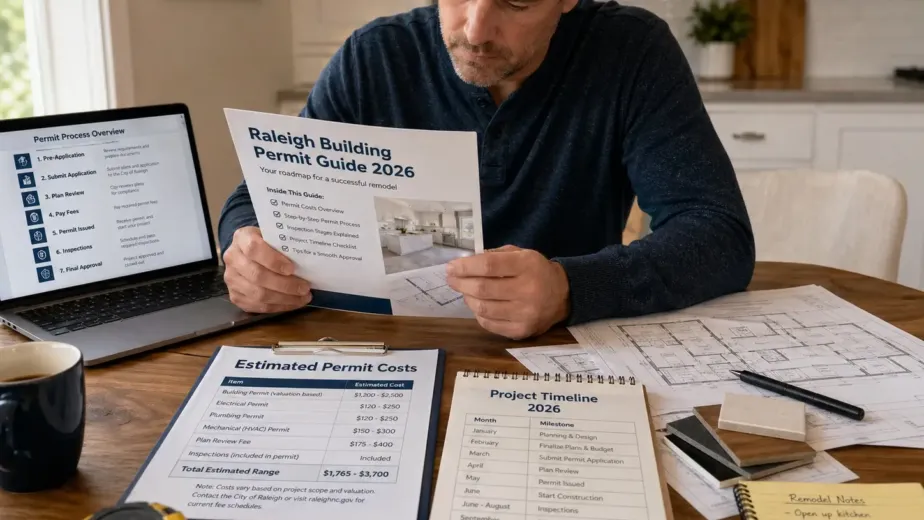
Most projects require plumbing, electrical, and building permits through the City of Raleigh Permit Portal.
For permit cost detail and timeline, see our Raleigh building permit cost and timeline guide.
A Real Cost Breakdown: 25 Sq Ft Half Bath in an Existing Closet
This is one of the most cost-efficient bathroom additions in Raleigh. The breakdown below assumes a short plumbing run (within 6 feet of the main stack) and standard finishes.
| Cost Category | Typical Range | What’s Included |
| Hard costs (construction) | $5,000 to $8,000 | Framing, drywall, finishes, basic tile |
| Soft costs (permits, plan review) | $400 to $1,000 | Building, plumbing, electrical permits |
| Plumbing tie-ins (short run) | $2,000 to $5,000 | Connection to existing wet wall |
| Electrical (light, fan, GFCI) | $500 to $1,500 | New circuit, exhaust fan, code-required GFCI |
| Contingency | $800 to $1,800 | Hidden conditions, scope adjustments |
| Total | $9,000 to $17,000 | All-in for a 25 sq ft closet half bath |
💬 HomeFREA Insight: The reason this cost breakdown lands at the low end is the assumption of a short plumbing run. Move the same closet to the opposite side of the house from the main stack, and the plumbing line alone can add $4K to $10K — pushing the total well above $20K for what looks like the same bathroom. Layout selection is the cost decision; finishes are a much smaller variable than most homeowners assume.
When a Cheap Bathroom Addition Stops Being Cheap
When Existing Plumbing Won’t Support It
Long distances from the main stack can double or triple plumbing costs and turn a $10K project into a $25K project.
When the Floor Plan Forces Long Runs
Sometimes layout forces plumbing through finished spaces, which increases labor for opening up walls and ceilings, then refinishing them.
When Hidden Conditions Surface
Older Raleigh homes may reveal:
- Old or undersized cast iron or galvanized pipes
- Improper venting that requires correction
- Electrical limitations that require panel work
- Knob-and-tube wiring in walls being opened
For older home considerations, see our Hayes Barton vs Five Points renovation reality check.
Permits and Timeline for a Raleigh Bathroom Addition
Permit Requirements
Most bathroom additions generally require:
- Plumbing permit
- Electrical permit
- Building permit
For specific requirements, see the City of Raleigh Permit Portal and the North Carolina State Building Code.
Send your address, photos, and a sketch of your idea. We evaluate your layout, identify the lowest-cost plumbing path, and provide a clear scope. Estimate turnaround typically within one business day after walkthrough.
Get a Bathroom Addition EstimateTwo Raleigh Bathroom-Add Scenarios
The following are illustrative scenarios drawn from typical Raleigh-area bathroom additions. Specific costs for any project depend on plumbing access, foundation type, finish selections, and home age.
Scenario 1: Under-Stair Half Bath in North Raleigh
A homeowner wants a guest bathroom on the main floor of a two-story home.
Site conditions:
- Plumbing stack is nearby (within 8 feet)
- Under-stair space is unused
- Crawl space access available for plumbing
Estimated cost: $12K to $18K efficient half bath
Scenario 2: Basement Full Bath in Cary
A homeowner is finishing a basement living area as a guest suite.
Site conditions:
- Long plumbing run from main stack
- Pump-assisted (macerating) system needed for toilet
- New electrical circuit and ventilation routing required
Estimated cost: $18K to $30K full bath depending on layout and fixture selection
Is Adding a Bathroom Worth It in Raleigh?
When the Math Works
- You are improving livability in a 2 to 3 bath home
- You are supporting a rental or guest suite
- Plumbing access is close to the proposed location
- Bathroom count is below neighborhood norms
When It Probably Doesn’t
- Plumbing runs are extensive and require significant rerouting
- Structural changes are required for floor support
- You are already at maximum bathroom count for home size
- The neighborhood ceiling won’t support the added value
For broader resale value context, consult a licensed Raleigh real estate professional before finalizing scope.
How HomeFREA Approaches Bathroom Additions
We focus on one thing first: identifying the cheapest viable plumbing path before design begins.
That generally means:
- Evaluating stack location before layout decisions
- Confirming whether a half bath is structurally feasible in the proposed space
- Avoiding unnecessary demolition or overdesign
- Providing a clear scope before construction begins
- Coordinating plumbing, electrical, and ventilation as a single system
For specific scope needs, see our bathroom remodeling services, whole home remodeling, and structural repair services.
We compare half bath, three-quarter bath, and full bath options where feasible based on your home’s actual plumbing layout. Free site walk and feasibility review within one business day.
Frequently Asked Questions
What is the cheapest way to add a bathroom to a Raleigh home?
The cheapest way is generally converting an existing closet or under-stair space into a half bath, especially if it is close to existing plumbing. Costs typically range from $8K to $22K depending on plumbing distance and finishes.
How much does it cost to add a half bathroom in Raleigh?
Most half bathroom additions in Raleigh range from $8K to $22K, with cost mainly determined by how far the plumbing must run from the main drain stack.
Can I add a bathroom under my stairs?
Yes, many Raleigh homes can support an under-stair half bath if there is enough headroom and nearby plumbing access. This is generally one of the most cost-efficient bathroom additions when the layout supports it.
How much does it cost to add a full bathroom in Raleigh?
Full bathroom additions typically range from $18K to $35K depending on plumbing access, square footage, and fixture selection
Can I convert a closet into a half bathroom?
Yes, closet conversions are common in Raleigh homes when plumbing is nearby. They generally produce the lowest-cost bathroom additions because they use existing framing and require minimal structural change.
Do I need a permit to add a bathroom in Raleigh?
Yes, most bathroom additions require building, plumbing, and electrical permits through the City of Raleigh depending on scope.
How long does it take to add a bathroom to a Raleigh home?
Most bathroom additions take 2 to 6 weeks of construction time depending on plumbing complexity, inspections, and whether structural changes are needed. Permit-and-design phase adds additional time before construction begins.
Can I add a basement bathroom without major plumbing work?
Sometimes, but many basement bathrooms require pump systems (such as macerating toilets) or extended plumbing runs if gravity drainage is not available. Pump systems generally add $1,500 to $3,000 but avoid much larger excavation costs.
Does adding a bathroom increase my home's value in Raleigh?
Additional bathrooms generally support resale value, but the actual increase depends on market conditions, layout, and execution quality. For binding valuation guidance, consult a licensed Raleigh real estate professional.
Does HomeFREA add bathrooms to Raleigh homes?
Yes. HomeFREA designs and builds bathroom additions across Raleigh and the Triangle, focusing on practical layouts and cost-efficient plumbing strategies. We provide feasibility walkthroughs, written scopes, and budget ranges before construction begins.
Key Takeaways
- Plumbing proximity to the main stack is generally the biggest cost driver
- Closet and under-stair conversions are usually the cheapest options ($8K to $22K)
- Full bathrooms cost more due to plumbing, ventilation, and shower waterproofing requirements
- Slab homes typically cost more to modify than crawl space homes
- Macerating toilets can avoid major excavation in difficult layouts
- Three-quarter baths often offer the best cost-to-function balance
- Older homes may surface electrical, plumbing, or venting issues that affect total cost
- Proper layout planning generally prevents expensive plumbing reroutes
Request a Bathroom Addition Estimate

If you are considering adding a bathroom, the first step is understanding where the plumbing can realistically go.
We evaluate your layout, identify the lowest-cost option, and provide a clear scope before construction begins.
Free site walk and feasibility review across Raleigh, Cary, Apex, Holly Springs, Wake Forest, Durham, and Fuquay-Varina. Typical estimate turnaround is within one business day after walkthrough, depending on scheduling volume.
This guide is educational and not legal, code, or engineering advice. Bathroom addition costs, plumbing feasibility, permit obligations, and structural requirements vary by property and project scope. Always confirm specific scope, budget, plumbing access, and permit requirements with a licensed general contractor, licensed plumber, and applicable Raleigh and Wake County authorities before relying on any information in this article.