
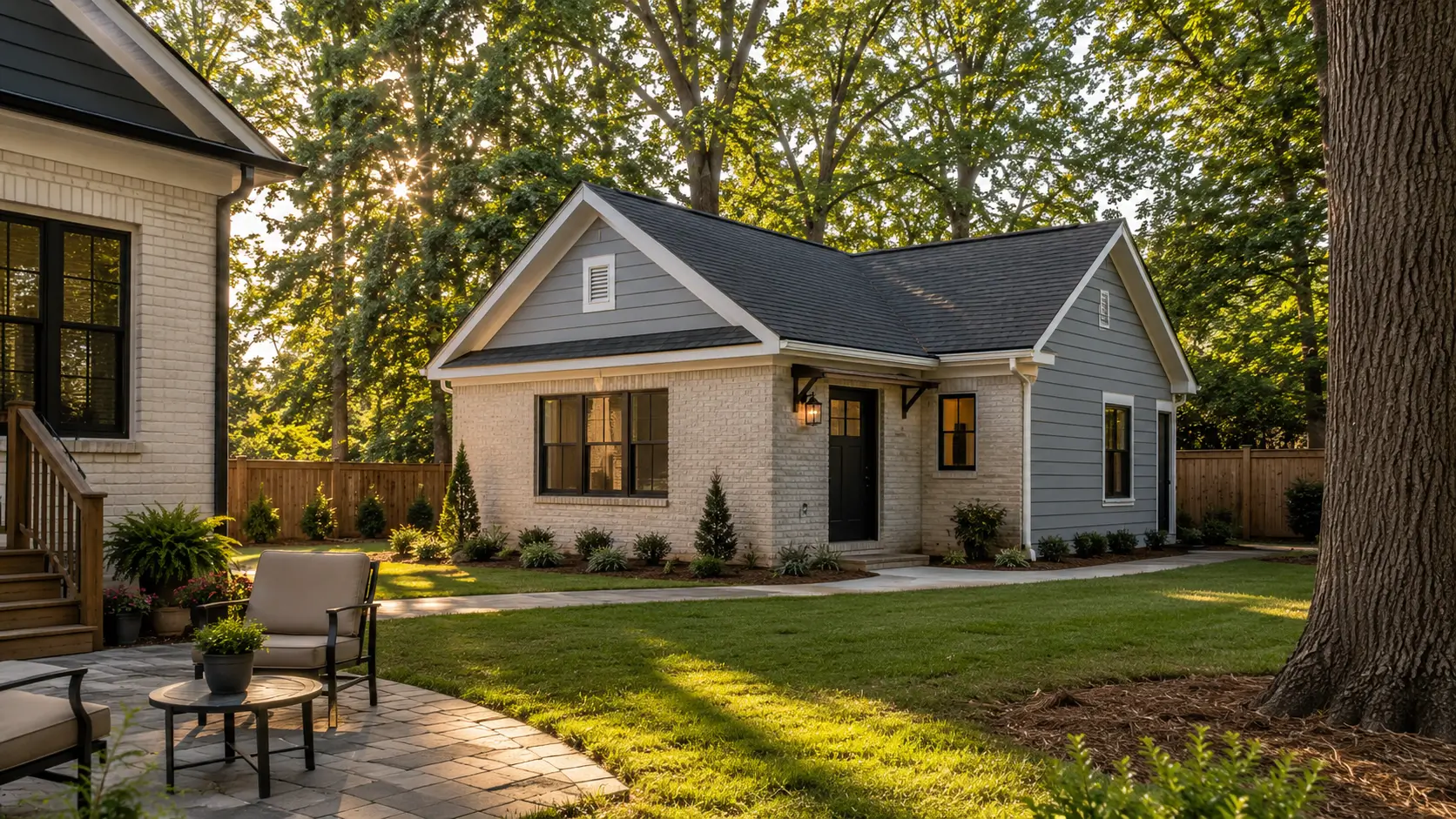
By HomeFREA — General Contractor serving Raleigh, Cary, and the Triangle · Reviewed by HomeFREA Editorial Team (NC Licensed General Contractor — NCLBGC verifiable) Last updated: May 13, 2026
Quick answer: ADU costs in Raleigh, NC range from $55,000 for a basic garage-to-ADU conversion to $500,000+ for a fully finished detached new build. Final cost depends on ADU type, square footage, finish level, utility routing, and whether the project uses the City of Raleigh Fast Track program.
- Detached new-build ADU: $250,000–$500,000+
- Attached ADU: $150,000–$300,000
- Garage conversion to ADU: $55,000–$180,000
- Internal/basement conversion: $80,000–$200,000
| ADU type | 2026 Raleigh cost range | Typical size |
|---|---|---|
| Garage conversion | $55,000–$180,000 | 250–600 sq ft |
| Internal/basement | $80,000–$200,000 | 300–800 sq ft |
| Attached ADU | $150,000–$300,000 | 400–800 sq ft |
| Detached new build | $250,000–$500,000+ | 400–1,000 sq ft |
If you are planning an ADU in the Triangle, you are probably looking for a real number before you call an ADU builder in Raleigh. ADU cost Raleigh NC searches can be frustrating because national averages do not explain what actually changes the price on a Wake County lot.
ADU pricing in the Triangle has shifted over the last few years. Demand is higher, labor is tighter, and Raleigh now has clearer zoning and permitting pathways. This guide does not give one fake “average.” It breaks down 2026 cost ranges by ADU type: detached new-build, attached ADU, garage conversion, and internal or basement conversion.
Here’s what each ADU type actually costs in Raleigh in 2026, what drives the price, and how the City’s Fast Track program affects the number.
What is an ADU in Raleigh? Quick definition and types
An ADU in Raleigh is a small, self-contained living unit on the same lot as a primary home, with its own kitchen, bathroom, sleeping area, living space, and lockable exterior entrance. The City of Raleigh defines ADUs as detached, attached, or internal units, and Raleigh also allows ADUs above a garage or in a basement. (Raleigh NC)
An ADU is different from a standard home addition because an ADU functions as an independent dwelling. Raleigh homeowners also call an ADU a backyard cottage, granny flat, in-law suite, or accessory dwelling unit. That is why searches like backyard cottage cost Raleigh, granny flat cost Raleigh NC, and accessory dwelling unit cost Wake County often describe the same project type.
Raleigh-permitted ADU types include:
- Detached ADU
- Attached ADU
- Internal ADU, including basement or above-garage space
- Two ADUs on one parcel, only in Frequent Transit Areas
The City of Raleigh’s ADU text change was adopted on July 7, 2020, and became effective on July 22, 2020. As a result, ADUs are allowed in R-1, R-2, R-4, R-6, R-10, RX, OX, NX, DX, and CX zoning districts. (Raleigh NC)
ADU cost in Raleigh by type: 2026 ranges
There is no single average ADU cost in Raleigh because build type drives the number first, then size, finish level, and utility routing.
The price per square foot for a Raleigh ADU is often higher than the price per square foot on a larger home addition. The reason is simple. A small ADU still needs a kitchen, bathroom, HVAC, electrical service, plumbing, insulation, life-safety details, and inspections. Those fixed-cost systems are spread across fewer square feet.
$250,000–$500,000+

A detached ADU in Raleigh typically costs $250,000–$500,000+ in 2026, with many full new-build projects landing between $300,000 and $400,000 depending on size and site conditions.
Detached ADU cost Raleigh numbers are higher because the project is basically a small custom home in the backyard. A detached ADU needs its own foundation, framing, roof, exterior envelope, HVAC, electrical rough-in, plumbing rough-in, kitchen, bathroom, insulation, drywall, finishes, inspections, and final certificate of occupancy.
The low end usually means a simple rectangular footprint, short utility runs, basic to mid-range finishes, and easy access for equipment. The high end usually means longer water and sewer routing, upgraded exterior materials, a more complex roofline, premium windows, higher-end bathroom remodeling selections, and a more detailed kitchen remodeling package.
A detached ADU can also drift into custom home building territory when the owner wants a highly customized layout, specialty finishes, vaulted ceilings, or a design that no longer behaves like a compact accessory unit.
The City’s UDO table shows 800 sq ft as the maximum for most standard residential lots, with a 1,000 sq ft maximum listed for residential lots over 40,000 sq ft. The UDO also requires an ADU to be smaller than the principal dwelling and constructed on a permanent foundation. (Raleigh UDO)
Common exclusions or separate line items include architectural design, stamped engineering, a site survey, landscaping, upgraded hardscape, and utility connection fees from City of Raleigh Public Utilities.
Attached ADU cost in Raleigh: $150,000–$300,000

An attached ADU in Raleigh typically costs $150,000–$300,000 in 2026 because the new living unit shares at least one wall with the primary home.
Attached ADU cost Raleigh ranges are usually lower than detached ADU pricing because part of the project can leverage the existing structure. Foundation work, roof transitions, water and sewer tie-ins, electrical routing, and mechanical planning may be simpler than building a separate backyard structure.
That said, attached ADUs are not always straightforward. A roofline transition can require careful framing. A wall shared with finished interior space can add protection, demolition, patching, and fire-separation work. An attached ADU tied into an older slab or crawlspace can also uncover hidden conditions once the wall or floor assembly is opened.
The biggest price swing usually comes from the tie-in. If the connection to the main home is clean, the project can stay closer to the middle of the range. If the main home needs structural reinforcement, utility upgrades, or major finish restoration at the connection point, the final number can move toward the high end.
Garage conversion to ADU in Raleigh: $55,000–$180,000
A garage conversion to ADU in Raleigh typically costs $55,000–$180,000 in 2026 and is often the lowest-cost path to a permitted, livable ADU.
A garage conversion to ADU Raleigh project costs less because the shell, foundation, and roof already exist. The work usually focuses on making the space legal, insulated, conditioned, safe, and livable.
A typical garage conversion adds insulation to code, electrical rerouting, HVAC, plumbing for a kitchen and bathroom, drywall, flooring, and finish carpentry. The garage door usually gets replaced with a permanent wall, exterior entry door, and often new windows for egress and natural light. If the project is really a new structure rather than a conversion, a garage addition may be the better service category.
Raleigh does not require additional parking to be provided with an ADU, so replacing a garage with an ADU does not automatically create a replacement parking requirement under the City’s ADU FAQ. (Raleigh NC)
Older garages need a careful first look. Sloped floors, drainage issues, inadequate footings, termite damage, undersized framing, and low ceiling height can change the scope quickly. A structural repair assessment is often the right first step before pricing finishes.
A one-car attached garage conversion usually sits near the low end. A two-car detached garage conversion with a full kitchen, bath, HVAC, upgraded windows, and higher finish level sits closer to the high end.
Internal or basement ADU conversion in Raleigh: $80,000–$200,000

An internal or basement ADU conversion in Raleigh typically costs $80,000–$200,000 in 2026 because the structure exists, but the life-safety and utility work can still be significant.
An internal ADU is built inside the existing home footprint. Common examples include a basement, above-garage bonus room, or carved-out portion of the main floor. This option often falls between a garage conversion and an attached new-build ADU on cost.
The framing may already exist, but the project still needs a separate entrance, kitchen rough-in, bathroom rough-in, HVAC planning, fire separation, electrical work, and emergency egress. Raleigh’s Residential Building Code for ADUs page notes that basement ADU rooms below grade need emergency egress stairs and emergency escape, such as window wells. (Raleigh NC)
This option is less common in many Wake County subdivisions because full basements are not typical in newer Triangle homes. Internal ADUs are more common in older Inside-the-Beltline Raleigh homes where basements, lower levels, or bonus spaces already exist.
How the Raleigh Fast Track ADU program affects your cost
The Raleigh Fast Track ADU program can reduce design cost and review friction by letting homeowners choose from a gallery of pre-reviewed ADU plans.
The City of Raleigh says Fast Track plans have been pre-reviewed for building code compliance before being added to the online gallery. Homeowners can view the Raleigh Fast Track ADU gallery and purchase plans from the designer for a fee far below typical custom design cost. (Raleigh NC)
Raleigh Fast Track ADU plans can reduce architectural design fees from a typical custom range of $8,000–$25,000 to a much smaller plan-purchase cost. Fast Track can also shorten early design work and reduce back-and-forth during plan review because the base plan has already been vetted.
Fast Track is not the right fit for every lot. The tradeoff is flexibility. A homeowner chooses from a finite gallery of designs instead of starting from a blank sheet. If the site has unusual slope, limited access, a historic overlay issue, tight setbacks, or specific lifestyle needs, a custom plan may still make more sense.
Fast Track ADUs still need a site plan and zoning review. Raleigh states that detached new ADUs and Fast Track ADUs follow the new single-family dwelling process, while garage and internal conversions follow the ADU change-of-use process. The City of Raleigh ADU permitting page explains the permit path by ADU type. (Raleigh NC)
6 factors that change your ADU cost in Raleigh
The final ADU cost in Raleigh changes most often because of size, utilities, finishes, site conditions, permit path, and long-lead selections.
- Square footage and layout complexity
A 400 sq ft studio ADU costs less than an 800 sq ft one-bedroom ADU, but not half as much. Kitchens, baths, HVAC, and electrical systems create fixed costs. Corners, roof breaks, vaulted ceilings, and custom built-ins also add labor. - Utility tie-ins
Water and sewer connection distance from the main house can change excavation, trenching, and restoration costs. Electrical service capacity matters too. Some homes need panel upgrades. Gas versus all-electric design also affects HVAC, appliance, and rough-in decisions. - Finish level
Basic, mid-range, and premium selections can shift the number quickly. Cabinetry, countertops, tile, plumbing fixtures, lighting, windows, flooring, and exterior siding all affect the final bid. - Foundation and site conditions
Slope, soil, drainage, tree protection, tight side yards, and limited equipment access can add cost before vertical framing begins. A flat, accessible backyard is simpler than a sloped lot with limited staging space. - Permitting path
Fast Track can reduce design time and some review friction. Fully custom plans cost more upfront, but they may fit the site better when setbacks, lot coverage, height limits, or lifestyle requirements make a gallery plan impractical. - Long-lead selections
Cabinetry lead times, fixture lead times, window packages, and certain tile selections can affect the schedule. Early selection reduces delay risk and helps avoid change order decisions after construction starts.
ADU permits, zoning, and timeline in Raleigh
You need a building permit for every ADU in Raleigh, plus separate trade permits for electrical, plumbing, and mechanical work.
Raleigh directs homeowners to apply through City of Raleigh Planning and Development and the Permit and Development Portal. For additions and accessory structures, the City lists required application materials such as a residential permit application, complete plan set, survey information, elevation drawings, and structural plans. (Raleigh NC)
The key Raleigh UDO rules are straightforward but site-specific. ADUs must be on the same lot as the principal dwelling, must have a lockable external entrance, must stay under ownership with the principal dwelling, and must be attached to or built on a permanent foundation. Two ADUs may be allowed only in Frequent Transit Areas. (Raleigh UDO)
For Raleigh homeowners on private well or septic, Wake County review matters before the City permit. Raleigh states that approval from Wake County Environmental Services is required before applying with the City when a property contains private well or septic service. (Raleigh NC)
A straightforward Raleigh ADU timeline is often 3–6 months from permit submittal to certificate of occupancy. Fast Track can shorten the front-end design and review period. A fully custom ADU can add 4–8 weeks before permit submittal if design, engineering, survey, or site planning takes longer.

How Triangle homeowners pay for an ADU
Triangle homeowners usually pay for an ADU with equity, savings, or a construction loan structure rather than a single standard financing product.
Common financing paths include:
- Cash from savings or sale of a previous home
- HELOC, or home equity line of credit
- Construction loan that converts to a permanent mortgage
- Cash-out refinance
- ADU-specific renovation loans, where available
Financing should be planned before design gets too far. A lender may need a scope, budget, appraisal assumptions, contractor information, and draw schedule. ROI, property value, appraisal treatment, and rental income assumptions should be discussed early because a lender may not value projected ADU rent the same way a homeowner does.
Always speak with a licensed lender about your specific situation. HomeFREA does not offer financing.
Frequently asked questions about ADU costs in Raleigh
How much does it cost to build an ADU in Raleigh, NC?
Most ADUs in Raleigh, NC cost $55,000–$500,000+ in 2026. Garage conversions start around $55,000, attached ADUs often run $150,000–$300,000, and detached new-build ADUs typically cost $250,000–$500,000+. Homeowners asking how much to build a granny flat should price by type, not one average.
How much does it cost to convert a garage to an ADU in Raleigh?
A garage conversion to ADU in Raleigh usually costs $55,000–$180,000 in 2026. The low end fits a smaller attached garage with simple finishes. The high end fits a larger detached garage with full kitchen, bathroom, HVAC, windows, upgraded finishes, and structural corrections.
What is the maximum size of an ADU in Raleigh?
For most standard Raleigh residential lots under 40,000 sq ft, the detached ADU maximum is 800 sq ft. The City’s UDO also lists 1,000 sq ft for residential lots over 40,000 sq ft. ADUs must be smaller than the principal dwelling and meet applicable height and setback rules.
How long does it take to build an ADU in Raleigh?
A straightforward Raleigh ADU often takes 3–6 months from permit submittal to certificate of occupancy. Garage and internal conversions can be shorter. Detached new-build ADUs often take longer. Custom design, engineering, site conditions, and long-lead selections can extend the schedule.
Can I rent out my ADU in Raleigh?
Yes, an ADU in Raleigh can generally be rented, but there is an important owner-builder exception. If the owner claims an Owner/Builder exemption instead of using licensed contractors, Raleigh requires a statement that the ADU will be built solely as Not For Rent before permit issuance. (Raleigh NC)
Will an ADU increase my property taxes in Wake County?
Yes. Adding an ADU typically increases the assessed value of the parcel, which Wake County reassesses for property tax. The size of the increase depends on the ADU type, square footage, and finish level. Homeowners should expect a property tax adjustment after the certificate of occupancy is issued.
Can I use my Raleigh ADU as a short-term rental like Airbnb?
Short-term rental of an ADU in Raleigh is regulated by the City’s short-term rental rules and Unified Development Ordinance. Operators generally need a Short-Term Rental Zoning Permit and must follow occupancy and operational limits. Confirm current STR requirements with City of Raleigh Planning before listing an ADU on Airbnb or VRBO.
Does an ADU need its own address in Raleigh?
Yes, ADUs in Raleigh are typically assigned their own address or unit designation (often the primary address followed by a unit number) for emergency response, utility service, and mail. Address assignment is handled during the permitting process through the City of Raleigh.
What is the ROI on building an ADU in Raleigh?
ADU return on investment in Raleigh varies by use case. Long-term rental income for a one-bedroom ADU in the Triangle commonly ranges from about $1,200 to $2,200 per month in 2026, depending on size and location. Appraisal lift and property value contribution are typically more conservative than projected rent. Owners should run their own numbers with a lender or appraiser before assuming ROI.
Get a real ADU estimate for your Raleigh-area lot
HomeFREA builds ADUs across Raleigh, Cary, Apex, Wake Forest, Holly Springs, and Fuquay-Varina. We review your lot, zoning, and goals and give you a real number for your specific project — not a national average. Our team coordinates trade sequencing, documents the scope before work starts, and closes out the project cleanly.
