If you are seeing sagging floors, sticking doors, or a musty crawl space in a North Carolina home, you are likely deciding between crawl space encapsulation and foundation repair — two completely different fixes that vendors often confuse. In short: encapsulation handles moisture and air quality; foundation repair handles structural movement. Some Raleigh-area homes need both. This guide walks you through symptom-by-symptom diagnosis, 2026 NC cost ranges, and how to avoid paying for the wrong scope.
By HomeFREA — General Contractor serving Raleigh, Cary, and the Triangle Last updated: May 8, 2026 • Reviewed by HomeFREA Editorial (NCLBGC-licensed General Contractor)
Editorial note: This article is educational and intended to help NC homeowners think through whether their home’s symptoms point toward crawl space, foundation, or combined issues. It is not a substitute for an in-person inspection by a qualified contractor or licensed structural engineer. Diagnostic accuracy depends on direct evaluation of your specific property’s conditions. Always confirm specific scope, structural concerns, permit requirements, and insurance coverage with a licensed general contractor, structural engineer (NCBELS-licensed), applicable Raleigh and Wake County authorities, and your insurance broker before relying on any guidance in this article.
TLDR: The Diagnostic in One Glance
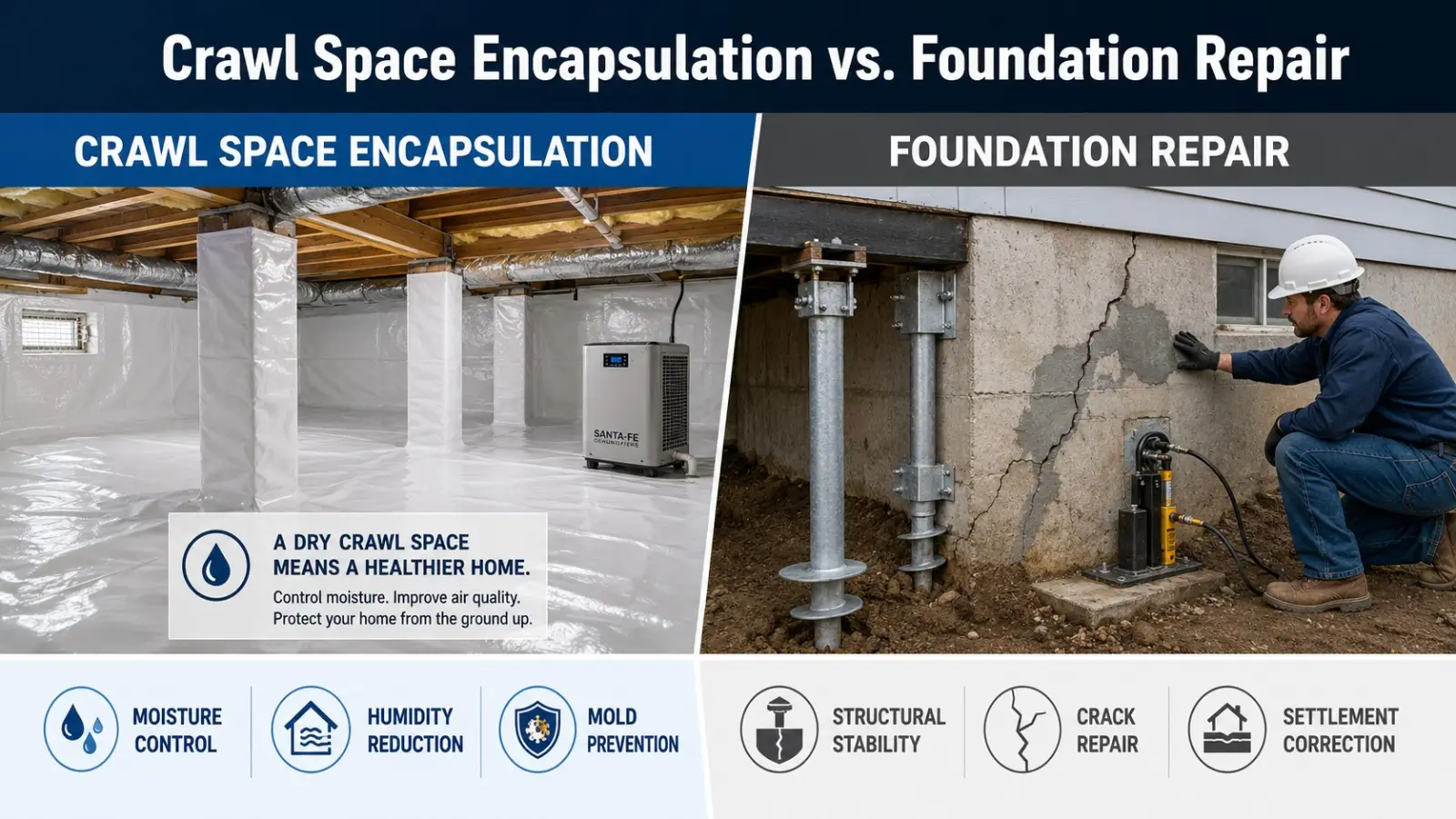
Most NC homeowners end up comparing crawl space encapsulation and foundation repair when they see symptoms like sagging floors, cracks, or musty odors. The key difference is this:
- Crawl space encapsulation is about moisture control and air quality under the home
- Foundation repair is about structural movement and load support
If your floors feel soft, your crawl space is damp, or humidity is high indoors, you are often looking at encapsulation. If doors stick, cracks are growing, or floors slope, you are more likely in foundation repair territory. Some homes need both.
In North Carolina, especially around Raleigh and Wake County, red clay soil and high humidity often make the two problems overlap, which is why diagnosis matters more than the first quote you receive.
Why NC Homes Have More of Both Problems

Red Clay Soil and Seasonal Movement
Much of Wake County sits on expansive red clay soil. This soil generally expands when wet and contracts when dry. That cycle slowly shifts footings, piers, and slabs over time. The movement is often gradual, but it shows up as cracks or floor slope in older homes.
More context on building performance under NC soil and humidity conditions can be found through the North Carolina Office of State Fire Marshal, which oversees state building code standards.
Humidity, Crawl Spaces, and Vented Foundations
Many older NC homes were built with vented crawl spaces. In a humid climate, those vents often bring moist air inside rather than drying anything out. Over time, this generally leads to mold, sagging insulation, and high indoor humidity.
The U.S. Department of Energy provides guidance on why unsealed crawl spaces often underperform in humid climates, and why conditioned (sealed) crawl spaces have become the standard recommendation for new construction in the Southeast.
Why the Two Issues Get Confused
Moisture can soften wood framing, which looks like structural failure. Meanwhile, minor structural movement can open gaps that let more moisture in. Homeowners often receive conflicting opinions because both systems interact — and because vendors specializing in one tend to find that solution.
This is why separating symptoms is generally more important than guessing the cause.
💬 HomeFREA Insight: The single most expensive mistake we see is homeowners getting one type of vendor (crawl space company) on a problem that is actually structural — or vice versa. The first vendor on site often anchors the diagnosis, and once $15K of encapsulation is installed without addressing real foundation movement, the symptoms come back and the budget is gone.
What Crawl Space Encapsulation Actually Is
Crawl space encapsulation is a controlled moisture and air sealing system installed beneath the home.
What’s Included in a Standard Encapsulation
Typical encapsulation in NC includes:
- Vapor barrier sealed across soil and walls
- Air sealing of vents and penetrations
- Crawl space dehumidifier
- Sometimes a sump pump system
- Insulation upgrades on walls or rim joists
The EPA Indoor Air Quality (IAQ) guidance addresses moisture control as it relates to crawl spaces and overall indoor air quality.
What Encapsulation Solves
Encapsulation is generally designed to address:
- High humidity in the home
- Musty odors
- Mold growth in crawl spaces
- Pest intrusion pathways
- Insulation deterioration
What Encapsulation Does Not Solve
Encapsulation generally does not correct:
- Structural sagging beams
- Foundation settlement
- Sloping floors caused by footing movement
- Broken or undersized joists
If the structure is already moving, sealing moisture alone will not re-level the home.
What Foundation Repair Actually Is
Foundation repair addresses structural movement in the load-bearing system of the home.
Pier and Beam Repair (Sister Joists, Re-shimming, New Posts)
Common in older NC homes:
- Replacing or reinforcing joists
- Adjusting support piers
- Installing new footings or posts
Slab Foundation Repair (Lifting, Stabilization)
Used when concrete slabs shift:
- Piering beneath slab
- Hydraulic lifting
- Crack stabilization
Perimeter Foundation Repair (Settlement, Cracks, Wall Movement)
This generally includes:
- Wall stabilization
- Soil anchor systems
- Crack repair tied to structural correction
Engineering oversight is often referenced through the NC Board of Examiners for Engineers and Surveyors (NCBELS), which licenses structural engineers in North Carolina.
What Foundation Repair Solves
- Structural movement
- Floor slope
- Door and window misalignment
- Foundation wall cracking
What Foundation Repair Does Not Solve
- Moisture control
- Mold prevention
- Crawl space air quality
- Humidity issues inside the home
Without addressing moisture, symptoms can return even after structural correction.
The Diagnostic Symptoms: What Your Home Is Actually Telling You
The table below maps common symptoms to their most likely cause:
Symptom | More Likely Crawl Space | More Likely Foundation | Possibly Both |
Sagging or bouncy floors | Soft floors with no visible cracks | Floors slope or dip in one direction | Both, especially in older pier-and-beam homes |
Sticky doors and windows | Less likely | Doors that suddenly stick or require force | Seasonal humidity changes can mimic this |
Hairline drywall cracks | Often cosmetic | Diagonal cracks near openings often structural | Stair-step brick cracks often foundation |
Musty smells / high indoor humidity | Strongly linked to vented crawl spaces | Less directly | Combined when crawl space exposes structure to moisture |
Standing water or wet insulation in crawl | High likelihood | Less directly | Both, when moisture has compromised framing |
Soft spots / spongy subfloor | Localized moisture damage to subfloor | Less directly | Possible plumbing leak or pest issue |
Chimney or exterior wall separation | Less likely | Foundation movement | Major settlement |
For crack interpretation context, see American Society of Home Inspectors (ASHI) guidance.
💬 HomeFREA Insight: The sagging-floor question is the one that confuses homeowners most often in older Triangle homes. If the floor feels soft underfoot but is still level, the issue is generally moisture-damaged subfloor — encapsulation territory. If the floor is dipping or visibly sloping toward one side of the home, the issue is generally settlement — foundation territory. The two problems require completely different repair strategies.
The Decision Framework: Which Issue Do You Actually Have?
Use the framework below to identify which direction your symptoms are pointing — but always confirm with a qualified inspection before committing to scope:
When It’s Probably Crawl Space
- Musty smell increases in summer
- Crawl space visibly damp or moldy
- High indoor humidity despite HVAC use
- Insulation falling or wet
When It’s Probably Foundation
- Doors and windows stick progressively over months
- Cracks expanding over time
- Floors visibly sloping
- Chimney or exterior wall separation
When It’s Both
- Older pier-and-beam home (1920s-1960s era)
- Crawl space moisture plus sagging floors
- Drainage issues around foundation
- Long history of deferred maintenance
When It’s Something Else Entirely
- Localized soft floor near plumbing fixtures (possible leak)
- Sawdust trails or termite tubes (pest issue)
- Hot or cold spots (HVAC imbalance)
Mold and moisture guidance can be reviewed through EPA mold guidance and CDC mold information.
For older homes specifically, see our Hayes Barton vs Five Points renovation reality check — homes from the 1920s to 1940s often show layered crawl space and foundation conditions due to age and prior repair history.
2026 Cost Ranges in NC
Repair Type | Typical 2026 Cost Range | Notes |
Crawl space encapsulation (basic) | $7,000 to $18,000 | Vapor barrier, air sealing, basic moisture control |
Crawl space encapsulation (full) | $10,000 to $25,000 | With dehumidifier and sump system |
Pier and beam repair (localized) | $2,000 to $8,000 | Single-area joist or pier work |
Pier and beam repair (major) | $15,000 to $40,000 | Significant structural correction |
Slab and perimeter foundation repair | $20,000 to $80,000+ | Depending on movement and access |
Combined work | $25,000 to $100,000+ | When both moisture and structural issues exist |
For permit cost detail on the construction work itself, see our Raleigh building permit cost and timeline guide.
How to Get an Honest Diagnosis Before Hiring Anyone
Why a Single-Vendor Diagnosis Is Often Unreliable
Crawl space companies tend to find moisture solutions. Foundation companies tend to find structural issues. Both may be correct in part, but neither is always complete.
What Independent Inspection Includes
A neutral diagnostic should generally evaluate:
- Structural leveling measurements
- Moisture and humidity readings
- Crawl space visual inspection
- Load path analysis
- Drainage and grading conditions around the home
When to Bring in a Structural Engineer
If movement is significant or unclear, a licensed structural engineer may be appropriate. NC engineer licensing is overseen by NCBELS. An engineer’s report carries more weight in disputed insurance or seller-disclosure situations than a contractor’s evaluation alone.
💬 HomeFREA Insight: The reason we separate diagnostics from repair scope is straightforward — we cannot offer an honest opinion on whether you need foundation work if the same site visit is also our sales pitch. Independent diagnostics generally save homeowners more money than they cost, because they prevent the wrong scope from being installed.
Send your address, photos, and any prior contractor reports. We provide a structured on-site diagnostic before any repair scope is finalized. Typically scheduled within 48 to 72 hours.
Two NC Diagnostic Scenarios
The following are illustrative scenarios drawn from typical NC homeowner diagnostic situations. Specific outcomes for any home depend on direct inspection findings.
Scenario 1: Sagging Floor in Raleigh
A homeowner sees soft floors and notices a musty smell. The initial assumption is foundation failure based on a single foundation company’s quote.
Inspection finds:
- Wet crawl space insulation
- High humidity readings
- No structural beam failure
- Subfloor water damage from long-term vapor migration
Result: Encapsulation with insulation replacement resolves symptoms. Foundation work was not required.
Scenario 2: Sticky Doors in Cary
A homeowner sees doors sticking and small wall cracks appearing over the past year.
Inspection finds:
- Soil settlement on one corner of the home
- Pier movement under a load-bearing wall
- Drainage issue contributing to soil saturation
Result: Foundation stabilization required. Encapsulation alone would not address the cause.
Permits and Inspection for Foundation and Crawl Space Work in Raleigh
Most structural repairs and encapsulation projects require permits depending on scope. Raleigh permit information is available through the City of Raleigh Permit Portal. For unincorporated property, check requirements with Wake County.
Structural correction work generally triggers permits with engineering review under the NC State Building Code. Encapsulation alone may or may not require a permit depending on scope of mechanical and electrical changes.
Insurance Coverage for Crawl Space and Foundation Issues
Foundation issues are typically excluded under standard NC homeowners policies as wear-and-tear or earth movement. Crawl space moisture and mold are generally also excluded unless they result from a covered water event (such as a sudden plumbing failure).
This is why early diagnosis matters: catching a sudden water-related cause within the policy window may preserve coverage that would otherwise be lost to “gradual” damage exclusions. For specific coverage questions, contact your insurance broker for a binding answer. Reference guidance from the NC Department of Insurance.
For broader water-related guidance, see our water damage in a Raleigh home guide.
How HomeFREA Approaches the Diagnostic and Repair
We separate diagnosis from repair scope.
That generally means:
- We inspect structure and moisture systems independently
- We document what is actually causing the symptoms
- We explain whether encapsulation, foundation repair, or both are needed
- We provide a written scope before work begins
- We refer to a licensed structural engineer when scope warrants formal engineering review
You can explore related services through our structural repair services, water damage repair services, and flooring installation services (when subfloor replacement is part of the scope).
Frequently Asked Questions
How do I know if I need crawl space encapsulation or foundation repair?
You can usually tell by symptoms. Moisture, musty odors, and humidity point toward crawl space issues. Cracks, sloping floors, and sticking doors point toward foundation movement. Many NC homes show both, so a full inspection is generally required to separate structural from moisture-related issues.
Are sagging floors a foundation problem or a crawl space problem?
Sagging floors can come from either, but in NC homes they are often caused by crawl space moisture weakening subfloor materials. If sagging is paired with cracks or visible slope, foundation movement may also be involved.
What does crawl space encapsulation cost in NC?
Most crawl space encapsulation projects in North Carolina range from $7,000 to $25,000 depending on size, moisture conditions, and whether dehumidifiers or sump systems are required.
What does foundation repair cost in Raleigh?
Foundation repair in Raleigh typically ranges from $2,000 for minor localized work to $80,000 or more for significant settlement correction depending on structure type, foundation type, and access conditions.
Do sticky doors mean my foundation is failing?
Sticky doors can indicate structural movement, but they can also be caused by humidity changes or seasonal wood expansion. A full inspection is needed to confirm cause before assuming foundation failure.
Can I do crawl space encapsulation myself?
Basic sealing is possible for some homeowners, but full encapsulation systems require moisture control design, drainage planning, and proper sealing. Incorrect installation can trap moisture and worsen conditions, so professional installation is generally recommended for full systems.
Will encapsulation fix mold in my NC home?
Encapsulation can reduce moisture conditions that support mold growth, but existing mold should be evaluated and remediated separately. EPA guidance generally recommends addressing both moisture source and existing contamination together.
Do I need a structural engineer before foundation repair?
Not always. Minor repairs may not require engineering review. Larger or unclear structural movement often benefits from evaluation by a licensed engineer through NCBELS. An engineer’s report also carries more weight in disputed insurance or seller-disclosure situations.
Is foundation repair covered by homeowners insurance in NC?
Foundation issues are typically excluded under standard NC homeowners policies as wear-and-tear or earth movement. Coverage depends on policy terms and cause of damage. Confirm specific coverage with your insurance broker for a binding answer. Reference guidance is available from the NC Department of Insurance.
Does HomeFREA do foundation repair and crawl space work in Raleigh?
Yes. HomeFREA provides independent diagnostics and repair planning for crawl space and foundation issues across Raleigh and the Triangle. We separate diagnostic walkthroughs from repair scope so homeowners can compare findings before committing.
Key Takeaways
- Crawl space encapsulation controls moisture and air quality
- Foundation repair addresses structural movement
- NC homes often show symptoms of both due to red clay soil and humidity
- Diagnosis generally matters more than the first repair quote
- Many issues overlap and require combined solutions
- Single-vendor diagnostics tend to favor that vendor’s specialty
- Older Triangle homes (especially pre-1960s pier-and-beam) often need both
- Insurance generally excludes both as wear-and-tear or earth movement
Request an Independent Diagnostic Walkthrough

If you are unsure what your home actually needs, we provide structured on-site diagnostics before any repair scope is finalized.
We evaluate whether the issue is crawl space related, foundation related, or a combination, then provide a written scope you can compare with any contractor or engineer.
Diagnostic walkthroughs are typically scheduled within 48 to 72 hours depending on demand in the Raleigh and Triangle area. Free site walk and written assessment.
More common questions
How long does crawl space encapsulation last in NC?
Most quality crawl space encapsulation systems in North Carolina last 15 to 25 years when installed correctly. The vapor barrier itself can last 20+ years, while dehumidifiers typically need replacement every 8 to 12 years. Annual inspections help extend system life and catch issues early.
Does crawl space encapsulation increase home value in NC?
Encapsulation often supports home value in humid NC markets by reducing moisture-related disclosures, improving indoor air quality, and lowering energy costs. While exact ROI varies, a transferable warranty and documentation of professional installation generally help during resale, especially in older Raleigh and Triangle homes.
Should I encapsulate before selling my Raleigh home?
If your crawl space shows visible moisture, mold, or sagging insulation, addressing it before listing usually prevents inspection-driven price reductions or deal delays. For a dry crawl space with no symptoms, encapsulation is generally not required pre-sale. A pre-listing inspection can help you decide.
Is it cheaper to fix the crawl space or the foundation first?
Foundation movement should generally be stabilized before encapsulation, because shifting structure can tear new vapor barriers and crack sealed wall transitions. If both are needed, sequencing structural correction first protects the encapsulation investment. A combined diagnostic helps prioritize correctly.
Quick glossary
Vapor barrier: A polyethylene sheeting installed across the crawl space floor and walls to block ground moisture from entering the home.
Encapsulation: A complete sealing system that converts a vented crawl space into a conditioned, dry space using a vapor barrier, sealed vents, and a dehumidifier.
Pier and beam: A foundation type common in older NC homes where the house sits on masonry piers and wood beams above a crawl space, rather than on a concrete slab.
Sister joist: A second joist bolted alongside an original joist to reinforce structural members weakened by moisture, sagging, or pest damage.
Settlement: Downward movement of a foundation as soil compacts or shifts, often producing diagonal cracks, sloping floors, and sticking doors.
Expansive clay: Soil (common in Wake County) that swells when wet and shrinks when dry, repeatedly stressing footings and slabs over time.